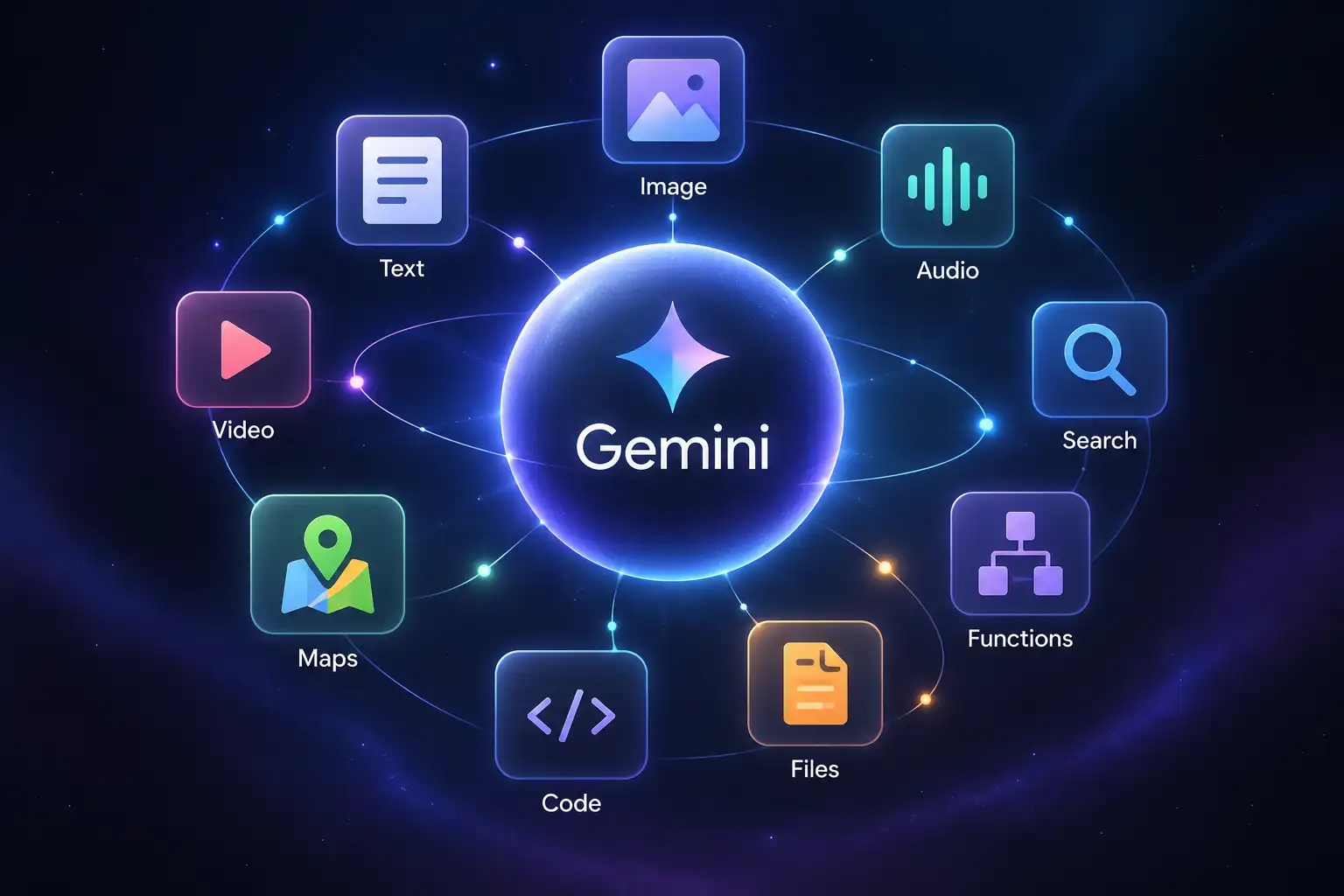
Gemini AI features is more than a search phrase. It describes a changing set of multimodal, reasoning, tool, realtime, speech, image, video, retrieval, and structured-output capabilities across Gemini products and APIs. The strongest strategy begins with a business or user problem, not with a fashionable model name.
This long-form guide is written for technology readers, product managers, developers, creators, and businesses evaluating Gemini capabilities. It explains the core concepts, architecture, practical use cases, selection criteria, security concerns, implementation steps, and future direction without assuming that one platform is automatically best for every workload.
Quick answer: Gemini AI features span multimodal understanding, built-in and custom tools, live interaction, speech and transcription, image and video generation, long context, and structured application output.
What does Gemini AI features mean?
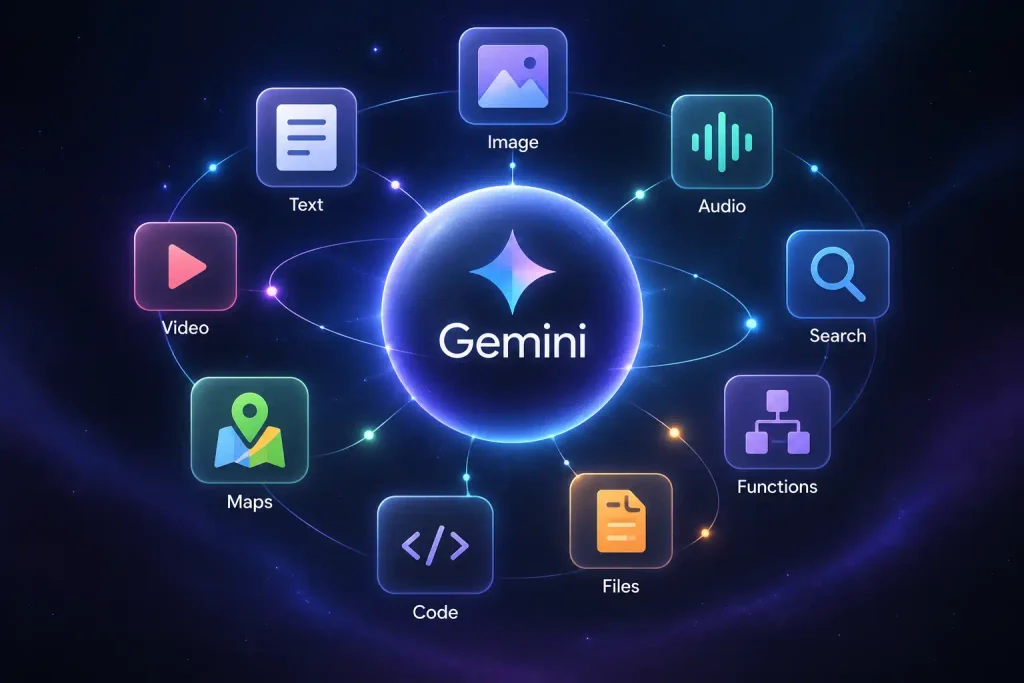
A feature belongs to a specific model, API, app, plan, region, or lifecycle status, so capability claims should always identify the relevant surface. In practice, the phrase covers a chain of decisions: the interface a user sees, the model that interprets a request, the data supplied as context, any tools the model can call, and the controls that decide what is allowed.
This guide groups features by the user problem they solve and highlights the checks needed before treating a preview or model-specific feature as a production standard. A strong explanation therefore focuses on outcomes and operational responsibilities rather than describing AI as an independent digital mind. Models generate outputs from inputs and learned patterns; applications must still manage identity, data access, verification, and accountability.
Current product snapshot: August 2026
The product snapshot for Gemini AI capabilities is deliberately time-stamped because model catalogs, preview endpoints, prices, and interfaces can change. Verify the linked official documentation immediately before publishing or making a production decision.
- The August 2026 model catalog includes general Flash and Pro models plus specialized image, live, translation, speech, transcription, video, robotics, research, embedding, and computer-use endpoints.
- Official tool documentation lists Google Search, Maps, Code Execution, URL Context, File Search, Computer Use preview, and Function Calling.
- Structured Outputs and tool combinations have model-specific support, so developers must verify current compatibility before implementation.
How Gemini AI capabilities works
For Gemini AI capabilities, reliable systems combine model intelligence with retrieval, deterministic software, permissions, monitoring, and human review. A request normally moves from a user or application into an API or product interface. The system may add instructions, retrieve approved information, call a tool, ask a model to generate or reason, validate the result, and then return an answer or action.
Gemini applications combine one or more input modalities with a selected model, optional grounding or action tools, and an output format appropriate to the user interface or downstream system. The exact implementation varies, but the following layers provide a useful map.
| Layer or capability | Role in the workflow |
|---|---|
| Multimodal understanding | Process combinations of text, images, audio, video, files, or code where supported. |
| Grounding and retrieval | Use current web, maps, URLs, or indexed files to add relevant external information. |
| Function and computer tools | Connect custom application functions or controlled user-interface actions. |
| Live and speech | Support low-latency dialogue, translation, speech generation, and transcription with specialized models. |
| Generative media | Create or edit images and video through dedicated Gemini-family media endpoints. |
| Structured and agentic workflows | Return schema-constrained results and coordinate multi-step work using supported tools. |
Where Gemini AI features creates practical value
The best use cases for Gemini AI capabilities have a clear input, a reviewable output, and a measurable benefit. They also tolerate the remaining uncertainty of probabilistic models or add deterministic checks where mistakes would be costly.
- Analyze product images, documents, and text together for support, accessibility, or catalog workflows.
- Build grounded assistants that search current sources or retrieve private documents and show supporting evidence.
- Create voice-first support or translation experiences with specialized live models and clear fallback behavior.
- Generate images or video concepts with media-specific review for brand, safety, rights, and factual representation.
- Produce structured records or invoke business functions while keeping validation and authorization in application code.
When piloting Gemini AI capabilities, start with one workflow that has enough volume to matter but is not so critical that an early error creates irreversible harm. This makes it possible to learn about prompt quality, tool reliability, user behavior, and support needs before expanding the deployment.
A step-by-step implementation workflow
- Step 1: Map each desired feature to a user outcome and confirm which product surface and model supports it.
- Step 2: Check stable or preview status, modalities, tools, limits, region, price, and expected retirement path.
- Step 3: Prepare evaluation samples that reflect real files, media quality, languages, lengths, and failure cases.
- Step 4: Prototype the smallest feature set and preserve source, tool, and model metadata for review.
- Step 5: Add permissions, structured validation, monitoring, and human approval before connecting external actions.
- Step 6: Recheck the model catalog and release notes before launch and at scheduled maintenance intervals.
Document the result of each step for Gemini AI capabilities. The goal is not simply to launch a feature; it is to create a repeatable process for deciding whether the workflow is ready, what may be automated, and where a person must remain responsible.
Architecture, data, and tool orchestration
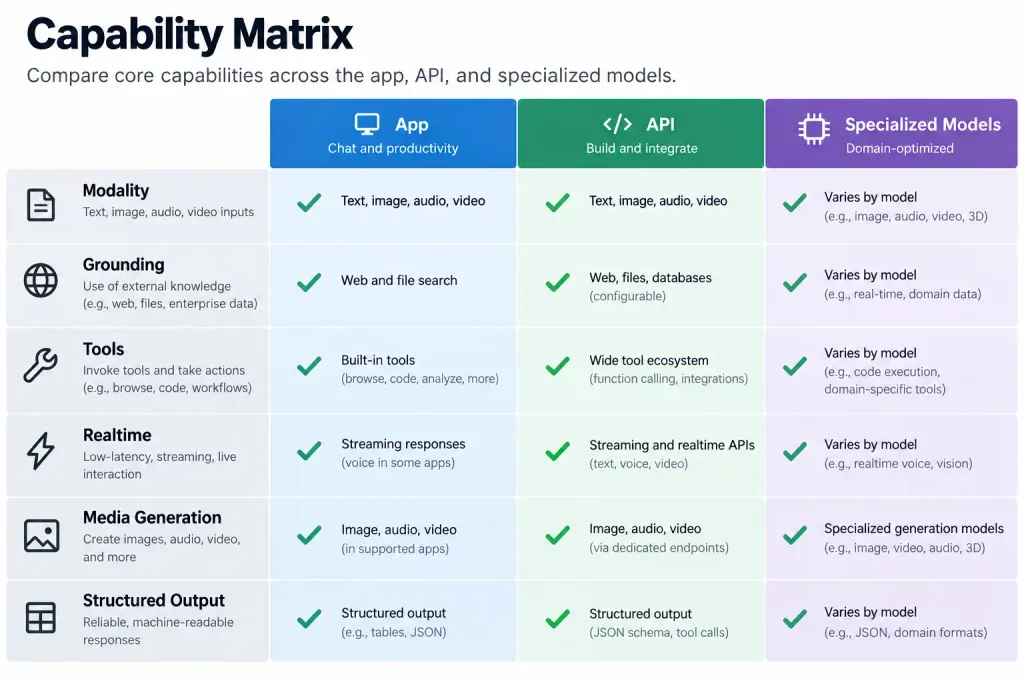
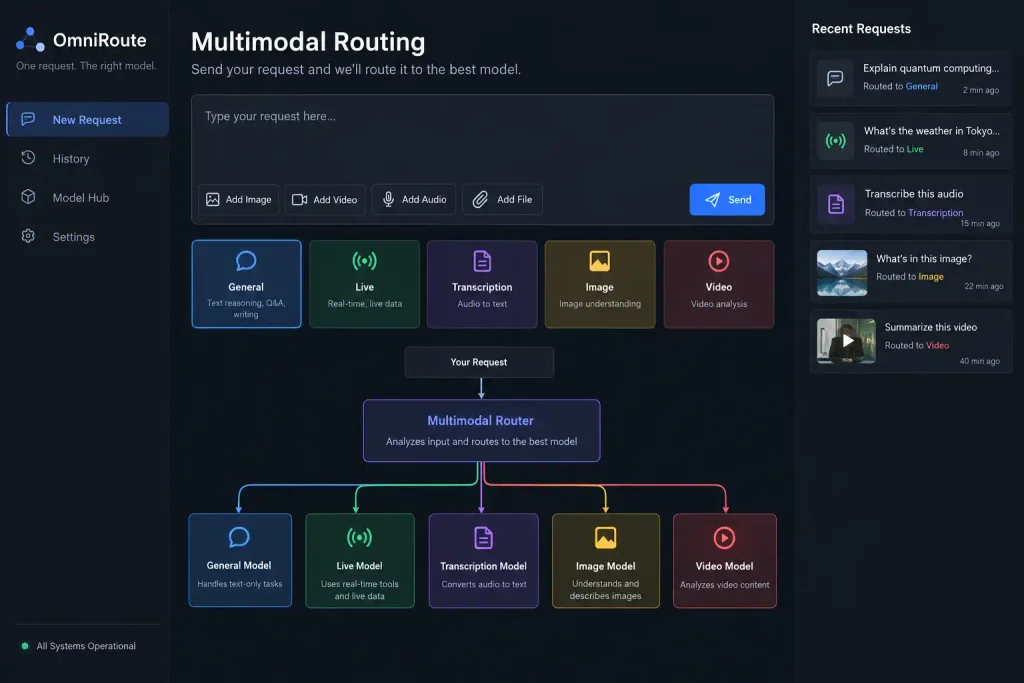
A feature matrix should be linked to model routing. The application can select a general model for most requests and switch to specialized live, transcription, image, or video endpoints only when the task requires them. Retrieval should use curated sources, tool definitions should be narrow and explicit, and every side-effecting action should have appropriate authentication and approval. A model can decide that a tool is useful, but the surrounding application must enforce what the tool is permitted to do.
Long context can be valuable in Gemini AI capabilities, yet sending more information is not always better. Irrelevant documents increase cost and can distract the model. A better pattern is to retrieve the smallest authoritative context, preserve source metadata, and evaluate whether the answer is supported by that evidence.
Security, privacy, and governance
Governance for Gemini AI capabilities should be designed with the workflow, not added after launch. Classify the data, identify the accountable owner, define prohibited uses, and decide when human approval is mandatory. Never place passwords, private keys, payment credentials, or unrestricted personal data in prompts or logs.
- Combining features from different app plans or model endpoints into one inaccurate capability claim.
- Using preview media, live, computer, or agent features without production fallback and lifecycle planning.
- Failing to evaluate low-quality images, noisy audio, long media, rare languages, and accessibility needs.
- Allowing grounded or retrieved content to inject instructions into the trusted application workflow.
- Adding expensive multimodal input and tool chains without cost allocation and user-level limits.
Security around Gemini AI capabilities should use least-privilege access for people, service accounts, connectors, and function calls. Protect stored data with appropriate encryption and retention controls. Keep an audit trail for high-impact actions, but avoid logging sensitive content that the team does not need. Review the whole application—not only the model provider.
Cost, performance, and platform selection
When selecting technology for Gemini AI capabilities, choose after measuring task success and total operating cost, not after watching a single polished demonstration. Evaluate at least quality, latency, context behavior, tool support, reliability, safety, regional availability, and total cost. A premium model can be economical when it prevents expensive corrections; a smaller model can be the better choice when the task is narrow and high-volume.
Choose features after deciding the required modality and outcome. A specialized model can outperform a general one for its intended task, but it also adds another API, evaluation set, and operational dependency. Build a small evaluation set from real requests, include difficult and adversarial cases, and score results with explicit criteria. Repeat the evaluation when the model, prompt, retrieval corpus, or tool definitions change.
Capacity planning for Gemini AI capabilities should include rate limits, peak concurrency, large file handling, streaming, retries, and fallback behavior. Track usage by product feature or customer rather than relying only on one organization-wide bill.
Common mistakes to avoid
- Starting with Gemini AI features before defining the task, user, acceptable error rate, and business owner.
- Treating a fluent answer as verified truth instead of evaluating Gemini AI capabilities on representative examples.
- Moving from a demo to production without permissions, logging, fallback behavior, or incident ownership.
- Comparing headline model capability while ignoring tool cost, data preparation, retries, and human-review time.
- Using preview or changing endpoints without a version policy, regression tests, and a documented rollback path.
Best practices for dependable results
- Maintain a live feature matrix with model ID, lifecycle, region, limits, owner, and last verification date.
- Use graceful degradation when a specialized model or tool is unavailable.
- Validate structured results and custom function arguments before downstream use.
- Obtain appropriate rights and consent for uploaded and generated media.
- Evaluate quality and safety separately for every supported language and modality.
Best practices for Gemini AI capabilities become meaningful only when they are testable. Convert each principle into a requirement, dashboard metric, automated check, or review checklist. Assign an owner and a review date so the controls evolve with the product.
Metrics that matter
A useful dashboard for Gemini AI capabilities connects technical behavior to user outcomes. The following measurement framework can be adapted to a personal project, startup, or enterprise deployment.
| Layer or capability | Role in the workflow |
|---|---|
| Task quality | Measure whether Gemini AI capabilities completes the intended job against a reviewed answer set or business acceptance rule. |
| Grounded accuracy | Track unsupported claims, citation quality, retrieval success, and the rate of answers that require correction. |
| Latency | Measure typical and worst-case response time, including tool calls, network delay, retries, and moderation. |
| Total cost | Include model usage, storage, retrieval, orchestration, monitoring, engineering, and human review—not token price alone. |
| Safety and reliability | Monitor blocked requests, policy violations, sensitive-data exposure, tool failures, and successful fallback behavior. |
| User outcome | Measure adoption, completion, satisfaction, escalation rate, and the real time saved by Gemini AI features. |
Questions to ask before choosing a service
- Which model or service version powers the proposed Gemini AI features workflow, and how are version changes announced?
- What data is stored, for how long, in which region, and for what product-improvement or safety purpose?
- Which built-in and custom tools are supported, and how are permissions, approvals, and tool results recorded?
- What rate limits, context limits, output limits, availability terms, and support channels apply to this exact account?
- Can the team export prompts, evaluations, logs, files, and configuration in a usable format if the architecture changes?
- How will cost be estimated and monitored when usage, context length, tool calls, or multimodal inputs increase?
The future of Gemini AI features
Gemini features are converging into broader multimodal and agentic experiences while specialized models continue to improve media, voice, transcription, and embodied workflows. The durable trend is a move from isolated chat responses toward systems that combine multimodal models, tools, private data, evaluation, and controlled action. At the same time, buyers are demanding clearer cost, governance, and reliability.
Because the technology supporting Gemini AI capabilities changes quickly, avoid building a strategy around one temporary model name. Preserve portable data, use documented interfaces, maintain evaluation sets, and keep the application architecture modular enough to test another model or service when requirements change.
Final verdict
Gemini AI features are extensive, but value comes from selecting a small compatible set and operating it well. Feature claims should stay tied to a specific model, lifecycle status, and review date. For most readers, the smartest next step is a focused pilot with clear success criteria and non-sensitive data. Learn from the results, strengthen controls, and expand only when the workflow proves useful and dependable.
Editorial freshness note for “Gemini AI Features: Multimodal Models, Tools, Live AI, and Media”: Product names, model availability, preview status, limits, and prices can change. This article uses an official documentation snapshot reviewed on August 31, 2026. Verify the linked sources before publication and schedule periodic updates.
Official sources and further reading
Frequently Asked Questions
What is Gemini AI features in simple terms?
Gemini AI features span multimodal understanding, built-in and custom tools, live interaction, speech and transcription, image and video generation, long context, and structured application output.
Who should use Gemini AI features?
It is relevant to technology readers, product managers, developers, creators, and businesses evaluating Gemini capabilities. The best starting point is a narrow, measurable workflow with clear review and privacy rules.
What is the most important part of Gemini AI capabilities?
The complete system matters, but Multimodal understanding should be evaluated together with data quality, tools, permissions, monitoring, and human responsibility.
How should a team evaluate Gemini AI features?
Use representative tasks, an agreed answer or acceptance rubric, and measurements for quality, latency, cost, safety, and user outcome. Repeat the evaluation after important changes.
Is Gemini AI features safe for sensitive data?
Safety depends on the service terms, account configuration, data flow, retention controls, access permissions, and the application around the model. Classify data and obtain appropriate security and legal review before using sensitive information.